This website is provided for educational purposes and does not represent legal advice. State and federal data center regulations are changing fast, and so are data center technologies and industry practices. While we try to keep this website up to date, we cannot guarantee the information is always 100% current. Please verify the information with your local government, when in doubt.
Frequently Asked Questions
Won't data centers raise my electric bill?
Investor-owned utility rates in North Dakota require Public Service Commission approval in public dockets. Large new loads are served under negotiated service arrangements.
North Dakota also has years of real experience integrating very large flexible loads.
What about our water?
All significant water appropriations require a permit from the North Dakota Department of Water Resources. The permitting system protects existing users first — the state applies a prior appropriation framework in which senior rights take priority, and permits can be conditioned or denied to prevent impacts on existing users. Data centers get no exemption. Modern facilities also increasingly use air cooling — well suited to North Dakota’s climate — which keeps water demand minimal.
Are data centers getting a free ride on taxes?
North Dakota’s qualified data center sales tax exemption requires facilities to meet state certification standards — including minimum investment — to receive it, and it applies to equipment, not a blanket pass. Projects generate local property value, construction employment, and permanent operations jobs in communities that host them.
What about noise?
North Dakota does not set a statewide industrial noise standard. Noise is regulated at the local level — several cities and townships have their own ordinances, and for projects on unincorporated county land, noise conditions are written into the conditional-use permit. Modern data centers typically commit to 55 dBA or lower at the nearest residential property line at night, verified by third-party acoustical studies, and that commitment becomes an enforceable condition of the local permit.
Who decides where these get built?
Your county and city. Zoning and siting conditions for data center buildings are local decisions made in public meetings. Backup generators require air permits through the North Dakota Department of Environmental Quality.
What does my community actually get?
Construction activity, skilled permanent jobs, expanded tax base, utility infrastructure investment, and oftentimes, grid upgrades that improve service for everyone on the line.
How do I know these rules will hold up?
North Dakota’s permitting and rate oversight organizations have handled large energy projects for decades — this state regulates coal plants, wind farms, pipelines, and transmission at scale. Data centers fit within a system built for big infrastructure, with public local and/or state dockets you can read anytime.
Geronimo Power is committed to conducting business with honesty, integrity, and respect. We expect our employees, third parties, and business partners to act ethically, uphold human rights throughout our operations, and speak up when concerns arise. To report a concern, please use one of the options below.
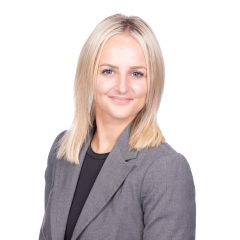
Sidney Nuese is a Senior Project Developer supporting the Nobles County Data Center through the development of its associated wind projects—Plum Creek 1, Plum Creek 2, and Lime Creek. A lifelong resident of southwestern Minnesota, Sidney brings deep local knowledge and nearly a decade of wind development experience. Since joining Geronimo Power in 2016, she has advanced multiple utility-scale wind projects across the region, building strong relationships with landowners and guiding projects from early siting through key development milestones.
She holds a bachelor’s degree in Business Management from Southwest Minnesota State University. Sidney lives near Hendricks, Minnesota with her husband, Jason, and their four children. Outside of work, she enjoys golfing and spending time on the lake.
Marta Lasch
Permitting Lead
Geronimo Power
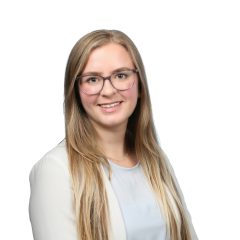
Marta Lasch is the Permitting Lead for the Nobles County Data Center, where she oversees environmental due diligence and land use permitting across local, state, and federal agencies. With nearly a decade of expertise working at the company, she has advanced over 1,600 MW of utility-scale wind, solar, and storage projects throughout the Midwest and Texas—550 MW of which are in Minnesota. Her work focuses on regulatory compliance, environmental risk mitigation, and coordinating with multiple agencies to advance major infrastructure projects.
Marta holds a B.S. in Geology from Iowa State University. Outside of work, she enjoys traveling and dancing with her husband, exploring state parks, gardening, and cheering on the Frost.